


KLA’s YouGov Profiles+ data tracks a sharp rise in online gambling since 2021, alongside growing unease and stronger support for a ban
Gambling website use among South African internet users has climbed from 24% to 41% in five years, according a study from KLA, the full-service market research agency and YouGov’sexclusive partner in Sub-Saharan Africa. Drawn from YouGov Profiles+, the analysis shows that over the same period more people have come to feel uneasy about how much they gamble. Some 42% now agree that they “really should gamble less” than they do, up from33% in October 2021, and 40% agree that all gambling should be illegal, up from 33%.
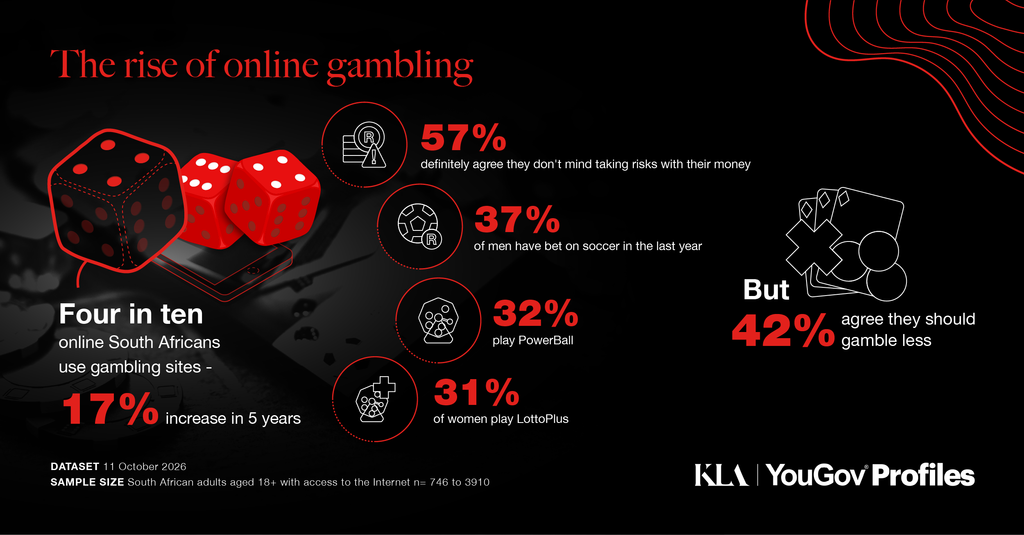
The 17-percentage-point rise in gambling site use is the largest shift among the measures KLA was able to compare with 2021. At 41%, gambling sites are now not far behind onlinegaming (50%) among the things South Africans do online, though still well short of streaming (63%) and online banking (82%). They have become part of the same daily routine of apps and websites people open without much thought.
The wider market tells the same story. According to the National Gambling Board, South Africans wagered more than R1.5 trillion in the 2024/25 financial year, almost a thirdmore than the year before, and around 60% of gambling revenue now comes from online play. That turnover figure counts every rand bet, including winnings that are bet again, so it is far larger than what players actually lose. Gross gambling revenue, the amountoperators keep, was R74.5 billion, up 25.6% on the previous year. Betting, which includes sports betting, made up 70% of that revenue and was the only form of gambling to grow. The Solidarity Research Institute estimates that online gambling grew by 390% between2021 and 2025, and in GeoPoll’s 2026 survey, 96% of South African bettors said they place bets on a mobile device.
The lottery remains the anchor of how South Africans gamble. PowerBall was played by 32% of online adults in the past 12 months, exactly the same share as in 2021. Casino-stylegames are where the growth sits: 28% now play slots, double the 14% recorded in 2021. Only 18% took part in none of the listed gambling activities, down from 22%, which means more than eight in ten online adults gambled in some form over the past year.
An earlier KLA analysis of YouGov Profiles+ data, from August 2026, shows how differently groups play. Men are far more likely to bet on sport, with 37% having bet on soccerin the past year against 22% of women, while women lean towards the Lotto draws: 31% play Lotto Plus (26% of men) and 32% PowerBall Plus (24% of men). Women are also twice as likely to play casino scratch cards, at 10% against 5%.
Each generation has its own habits. Gen X are the country’s core lottery players, with 39% playing PowerBall and 38% each playing Lotto Plus and PowerBall Plus, yet 29% of themtake part in none of the listed activities, more than double the 12% of Gen Z. Millennials are the most active sports bettors, with 37% having bet on soccer, compared with 29% of Gen Z and 18% of Gen X. Gen Z are drawn to casino-style games that are increasinglyplayed online: 18% play roulette against 5% of Gen X, 14% poker against 5%, and 13% craps against 3%.
Income draws a clear line through lottery play. In the August data, PowerBall participation reached 39% among those earning R10,000 to R19,999 a month and 40% in the R20,000to R39,999 band, falling to between 21% and 25% for those earning R40,000 or more.
Yet it is higher earners who feel the most conflicted. In the October data, 35% of higher-income respondents definitely agree that they should gamble less, compared with 21%of lower-income respondents, and 38% definitely agree that all gambling should be illegal, against 20%. Men (28%) are more likely than women (22%) to definitely agree they should cut back, and the feeling peaks among 35- to 44-year-olds, at 30%. Overall, theshare who definitely agree they should gamble less has risen from 18% in 2021 to 25%.
That concern does not mean people have lost their appetite for risk. Among those who definitely agree they should gamble less, 57% definitely agree that they don’t mind takingrisks with their money, compared with 27% of those who definitely disagree. Views on a ban are firming at both ends too. The share who definitely agree that all gambling should be illegal has grown from 18% to 24%, while those who definitely disagree haveedged up from 16% to 18%, and 24% remain neutral.
Nor is gambling simply a hardship story. Respondents who said their household finances were worse than a month earlier were no more likely to gamble: 24% of this group tookpart in none of the listed activities, compared with 15% of those whose finances were unchanged and 18% of those who were better off. The group is small, at 101 respondents, so the result should be read with caution, and a one-month view of household financesis not the same as long-term pressure on the cost of living. Money still matters. In Old Mutual’s 2025 Savings and Investment Monitor, 52% of working South Africans earning R8,000 a month or more said they gamble, with making extra money the main reason given.
“The lottery is the backbone of gambling in South Africa, and it is most popular among lower- and middle-income earners hoping for a change in fortune,” says Rakhee Naik, ManagingConsultant – Insights at KLA. “What stands out is how many people feel they should be doing less of it. That tension between hope and restraint should interest financial services brands in particular. The pull of possibility is a powerful motivator, and savingsand loyalty products that build in an element of chance and reward may connect with people in a way that pure utility doesn’t.”
“When gambling lives on the same phone as banking and streaming, usage data alone stops telling you the whole story”, says Naik. “If you looked at usage alone, you would callthis a booming category but while people are playing more, they are also feeling more uncomfortable about it. The brands that stay credible will be the ones that measure how their audience feels, not just how often they show up, and shape their tone and responsible-playpositioning around that.”
The scrutiny is not only coming from consumers. National Treasury has proposed a 20% tax on online betting revenue, and the National Gambling Board has flagged influencer advertising,particularly content aimed at younger people, as a concern. For marketers, the data describes two quite different audiences: a lottery-led mainstream, concentrated among Gen X and lower- to middle-income earners, and a younger, more male group that favourssports betting and casino-style games. Both carry a growing sense of unease, and a category-wide average hides how sharply attitudes differ by income, age and gender. What the numbers cannot show is why people play, whether for entertainment, habit or thehope of a big win. That takes research that asks them directly.


